

Listen, we’re not talking about Keanu Reeves and his gang here. This is an article on skills matrix – what it is, why it’s needed, and how it can help your staff and the business with planning, development, and staff retention. Upskilling your workers is more important now than ever, with shifting labour markets and the increase in AI, hybrid working, and rapid transformations. We’ve even provided a skills matrix template to help get you started.
Defining a skills matrix
So what exactly is a skills matrix?
Also known as a competency matrix, skills map, or capability matrix, a skills matrix is a grid that maps workers, or roles, to the skills they possess, along with a rating to show how experienced each worker is at each skill.
It’s a good idea to have a skills matrix to visualise what skills there are in your business, where the gaps are, and where to focus on hiring, learning, or redeployment. The sorts of skills listed are hard skills, soft skills, qualifications, and behavioural skills.
What needs to be included is the skill, the proficiency of each employee (rated by a number), and the interest of the employee in that skill – also with a number, to show how motivated each worker is to apply themselves or develop that particular competency.
The benefits of creating a skills matrix
- Identifies skills gaps – shortfalls in skills become obvious when comparing current skills versus required ones.
- Optimises the allocation of resources – as it helps to match up employees with roles or certain projects based on their strengths.
- Prioritises development and training – companies can direct learning and development investment to the most appropriate areas.
- Emphasises succession planning – by swiftly identifying leaders, potential sideways moves, and upskilling requirements.
- Supports workforce planning – by aligning internal promotions or moves with business needs, along with redeployment and career transitions.
Why a skills matrix is vital in today’s market
There is a skills shortage in the UK
- An Employer Skills Survey from 2024 revealed that there were 250,500 skill shortage vacancies.
- This is a drop from previous years, but still remains significant.
- The report also noted that there was a reduction in the skills gap density, which is the proportion of employees with skills gaps, comparable with previous years.
There is a mismatch of qualifications
- The Office for National Statistics (ONS) found that 2.3 million of working age people had the potential to perform roles in other occupations, meaning these skills were transferable, which hints at an underlying mismatch of skills.
- The same study showed that just over half (52.5%) had obtained qualifications that matched the average for their occupation, with 20% overqualified for the positions they had.
There is a talent shortage
- A talent shortage survey from 2024, conducted by Manpower, found that 80% of employers in the UK are experiencing an 18-year high of talent shortfalls.
To redress the balance of the economic cost of skills gaps
- Research cited by Enterprise Skills Ltd has found that employers shell out over £6 billion on an annual basis in costs related to skills shortages, on things such as temporary staff, upskilling, and recruitment.
- The same report showed that investment in training is decreasing, with a fall from £1,960 per employee in 2022 to £1,700 in 2024, with an overall decline of 29.5% since 2011.
The demand for future skills
- A study carried out by Skills England, on behalf of the UK government, predicts that employment demand in priority sectors, which includes clean energy and housebuilding, will grow by 0.9 million from 2025 to 2030, faster than non-priority sectors.
- Two thirds of that demand will require employees to obtain qualifications at higher technical or degree level.
A step-by-step guide to building a skills matrix
Now let’s use the guide below to create a skills matrix that can be distributed across the whole company, along with a visual mock-up of a skills matrix template that can be tailored to suit your organisation.
- Define goals – what exactly is it that you want the skills matrix to achieve? It could cover identifying gaps, planning learning and development, supporting internal moves, and / or outplacement.
- Decide on the scope – do you want it to work for the whole organisation, just one department, or a particular project team?
- Focus on the right competencies – pick out the relevant skills that will transform your staff and the business, as well as future skills needs on priority sectors that have been highlighted by the UK government. Include a mix of technical and soft skills as well as qualifications, and deploy a career framework that aligns with sector skills.
- Choose a rating system – decide how to assess skill levels, such as a 1 – 5 scale or something along the lines of “beginner,” “intermediate,” “advanced,” and “expert,” with each rating having a clear definition.
- Create a skills matrix template – you can customise the skills matrix template provided below for starters, or use a spreadsheet for simplicity, inserting columns with names of employees and rows listing each skill along with a rating. As you become more familiar with it, extra columns or rows can be added with headings like “Last assessed,” “Desire to grow,” and “Training planned.”
- Fill in the skills matrix – do this by engaging with the team and asking managers and peers for their input, while ensuring consistency with ratings via manager reviews or peer calibration discussions.
- Watch out for gaps and prioritise training – analyse any gaps that pop off the page, map them to business objectives, and use the matrix to prioritise critical training and hiring.
- Take action – draft development plans for workers that include training and mentoring, then link this to the career path framework related to internal promotions or redeployment.
- Set time-related reviews – whether that means updating the skills matrix every month, every quarter, or every time a member of staff has a performance review.
- Track and review – consistently monitor changes to see how skill proficiencies are improving, then use either positive or negative data to inform the leadership team, re-adjusting if needs be.
A skills matrix template
Here is a simple version of a skills matrix template that can be adapted to suit the needs of any department or organisation.
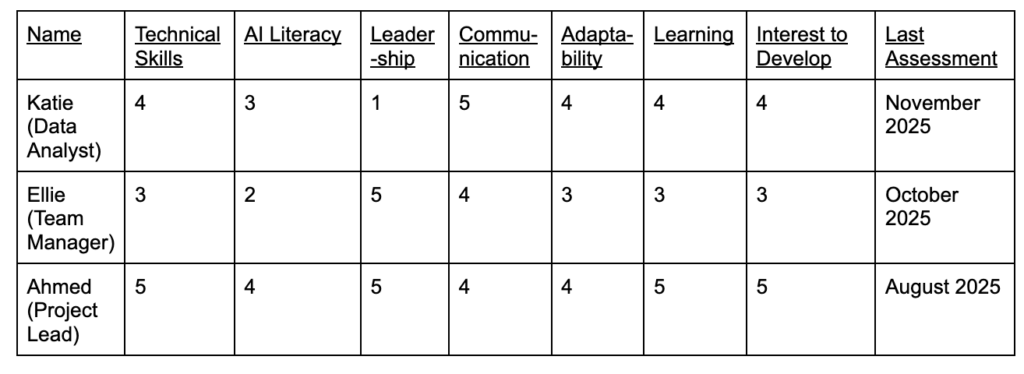
(Rating: 1 = Beginner – 5 = Expert; Interest to Develop – self-rated)
Reading the skills matrix template would go something like this …
- Katie (Data Analyst) shows commendable communication techniques and adaptability, while being keen to learn, so could be seen as an ideal candidate for cross-functional training.
- It’s clear that Ellie (Team Manager) has a lower digital and AI literacy understanding, but is moderately interested in development, which shows how a skills gap can lead to a focused learning and development pathway.
- Ahmed (Project Lead) is highly skilled at a technical level with strong learning capabilities, leading to the idea that he could either be redeployed as a leader or make a great mentor.
Mitigating any challenges
It’s worth noting that you’ll need to encourage staff to invest in using a skills matrix, and take it all on board, which means that you might come across some resistance at some point.
Below is how to address the most common pitfalls.
Lack of engagement – if members of the team involved don’t see the point of a skills matrix, it just becomes a tick box exercise with no real value or point to it. The answer here is to clearly communicate its purpose, highlight the benefits to the individual, and involve them when setting goals.
Subjectivity during self-assessments – workers can either underrate or overrate themselves depending on their personality. The solution to this is to marry their ratings with their manager and / or peer rating to get a consistent overview.
Too many skills – if the skills matrix is too crowded, it becomes unmanageable and thus avoided. The trick is to make sure it only contains the most business-critical skills.
No follow-up or action taken – if actions aren’t taken to rectify skills gap or move employees forward, the skills matrix will become like wallpaper – ignored. So once analysis has been completed, tie this in with specific action plans, learning and development, and succession planning.
Key takeaways on building a skills matrix
- A skills matrix is a simple yet powerful tool that maps, analyses, and improves skills across the workforce.
- It’s a strategic necessity in the UK due to the heightened skills shortages, economic cost, and future demand.
- You can start small, layering up your company’s skills matrix over time, by building collaboratively and reviewing often.
- Why not pilot a skills matrix today? Choose one department to focus on initially, connect it with the company’s policy on career progression, and monitor the impact.
If you need help with this, or any other career framework and outplacement processes, contact us to find out more.




Do you require outplacement support?
People are our priority. That is why we have customised talent management solutions at competitive prices that work across every level.